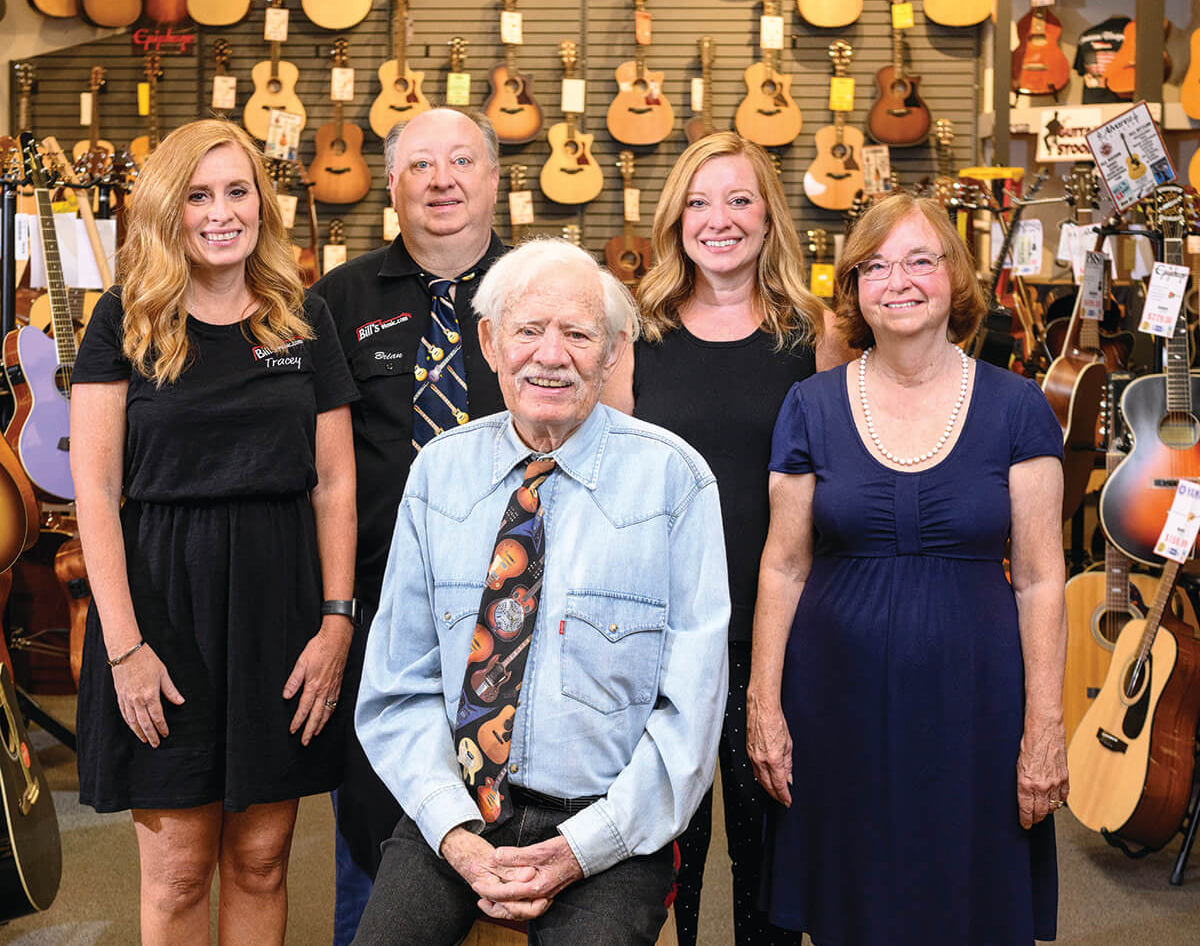
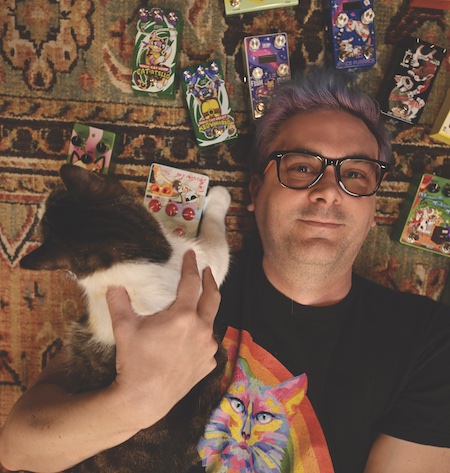
Brian Hansen of B’s Music Shop
From focused social media strategies to shifting buyer demand, three guitar retailers from across the country share how they’re navigating today’s market — and what it takes to stay relevant in 2026. The following article is from the May issue of Music Inc.
THE COOL CAT OF GUITAR RETAIL
B’s Music Shop in Mount Pleasant, Michigan, has purr-fected the power of branding. In 2026’s social media-driven sales landscape, authenticity goes a long way and B’s has tapped into just that with its cat-themed branding, a slew of special edition cat-themed effects pedals (Google: the Meowdulator) and even its own line of catnip toys.
At first, it was just a joke: cats, guitars and a music store that didn’t take itself too seriously. Then someone turned that idea into a logo — think skull and crossbones but reimagined with a feline twist. That’s when everything changed. What began as a playful idea has turned into a defining identity for B’s Music Shop, which is based in Mount Pleasant, Michigan (or Meownt Pleasant if you ask the store’s team). That led store owner Brian Hansen to realize that if customers were paying attention, he might as well lean all the way in.
“The cat branding came out of a long-running joke. For years, I used to joke that I ran a cat guitar pirate ship, because I honestly wasn’t sure how to describe to most people what I did for a living,” Hansen explained. “After somebody made me a skull-and-crossbones logo using guitars and cats for our anniversary, we ran with it. We put it on hoodies and T-shirts. And we’ve sold an unbelievable number of shirts — something like a thousand a year. You see them all over YouTube. But the cat branding just kept growing, and eventually I figured, well, if that’s what everyone wants me to be, I’ll lean into it. Most people who do my job are 60 or 65 years old, and I wanted to be something a little more fun. So, when the cat thing got adopted as my brand, I just went with it. The internet likes cats, and I want my music store to be on the internet. Plus, I do have five cats.”
Leaning Into Authenticity
After the cat branding began to take hold, B’s Music Shop leaned further into its feline identity. Now a multi-year NAMM Top 100-recognized dealer, B’s Music Shop has started channeling that same playful energy into a line of store-exclusive “cat effects” pedals — or what Hansen described as “little art projects” made in partnership with major pedal manufacturers that gave him increasing creative freedom. What began as a handful of cat-themed designs has grown into a family of nearly 28 pedals, anchored by the Meowdulator, which has sold more than 1,500 units.
“Pedal makers have told me they can’t believe the sales numbers,” Hansen said. “That raises a real question: How do you survive as a music retailer in 2026? You stitch together a lot of different revenue streams, and it looks different for everyone. You can put your inventory online, but a lot of stores have the same inventory. You can sell on Reverb, but the fees eat you alive. At some point, I realized I needed to focus on being a brand rather than just another retailer who showed up on the internet.”
For Hansen, the pedal line isn’t just a branding exercise, it’s become roughly a third of the store’s total revenue, a lifeline in an era of rising costs and tightening margins.
“I spent years studying stores that had built real brands, not just retail presences, and decided I needed to do the same,” he said. “We’re located in the middle of central Michigan — we’re not a major metro store. But people on the internet genuinely thought we were in Chicago or some other big city. In a small college town in Michigan, the internet levels the playing field more than you’d expect. So, I invested heavily in better cameras, cinematography and production quality to make our online presentation stronger.”
And that investment has paid off. The cat pedal videos alone have helped expand B’s Music Shop’s footprint on YouTube, with the Meowdulator demo video grabbing some 56,000 views. B’s Music Shop’s Instagram account currently has 20,800 followers — proof, Hansen said, that today’s online audiences crave authenticity.
“To drive our social recognition, I decided to put myself on camera and see what happened,” Hansen said. “I acted a little goofy and leaned into being authentic. It started connecting. We did brand collabs with manufacturers, and I started riding the line between content creator and store owner. And, yes, that does lead to sales.”
One example Hansen looked to was pedal maker JHS’ model.
“Not every piece of their content is a direct sales pitch,” he said. “So, sometimes I just have a product, and I make a dumb joke with it — no pitch, just a bit. I think it’s mostly about showing up every day, being authentic and throwing things out there. I try to make a lot of content. I used to joke that I’m not the greatest guitar player, but I can make content in weird and infinite quantities. I get on camera and say weird stuff, and people either find it funny and follow us, or they hate me. Either way, I’m zeroing in on my market and my people.”
Brand Identity in Every Detail
B’s Music Shop has also been sure to showcase its brand identity in everything it does, including incorporating its unique logo into every facet of the customer experience.
“We have our own tape and stickers, and our boxes are printed with our logo. It costs a little, but it makes us feel like a real operation that has its act together,” Hansen said. “I’m also most likely the only music retailer with my own branded cat toy.”
That’s right, B’s Music Shop has its own guitar pedal-shaped catnip pillows.
“We sell them online constantly,” Hansen said. “We order them in batches of 5,000 at a time, and we’re on our third batch now. We send them out to companies, too. For example, Orange Amps sent a batch to their team and all their cats were playing with them. So, I’ve tried to really focus on being a brand and doing a great job with what I can bring to the table, rather than just being another retailer posting, ‘Here’s the new thing every other retailer is also selling this month.’”
Or, as Hansen might have put it, “selling right meow.”
— By Katie Kailus
B’s Music Shop’s Pro Tip
“When it comes to running a guitar shop, it’s really about figuring out who you are and what your own voice is — not just from a content standpoint — but as a business, says Brian Hansen, owner. “Figure out the audience you connect with and lean into that connection. There’s no single formula. Finding your voice, knowing your strengths and building your audience around those things is genuinely hard to replicate. And that’s what makes it valuable.” MI
______________
KEEPING GUITAR RETAIL PERSONAL
In an age where a new guitar is just a click away, Thunder Road Guitars is investing in the brick-and-mortar experience. Its latest space is designed to bring players back into the shop, and keep them there.
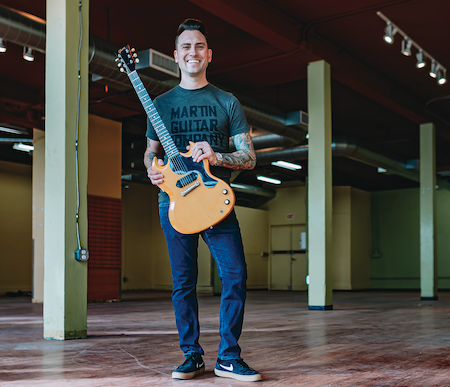
While many guitar retailers in 2026 are leaning into building up their e-commerce presence, Seattle-based Thunder Road Guitars is doubling down on brick-and-mortar retailing. Owner Frank Gross said he wants customers to feel the instrument in their hands, hear it in the room and connect with his staff who genuinely care about their playing experience.
“Part of why we want to invest in a bigger brick-and-mortar presence is because anyone with a computer can hop on Reverb, eBay or Musician’s Friend and find an instrument,” Gross said. “What we want to do is give someone an experience they can’t get online, in a genuinely welcoming and beautiful environment.”
And the design of Thunder Road Guitars’ brand new yet-to-be-opened showroom in Seattle aims to do just that.
“The design of our new store is really aimed at giving people a reason to get off their computer, get in their car and come see us in person,” he said. “And I’m really excited about it.”
Sound You Can See
Gross has been working at music stores since he was 16, sweeping floors and tuning guitars. When he founded Thunder Road Guitars in 2011 in a one-bedroom apartment, he launched with just an e-commerce site — something Gross said was unfounded when he started in the industry as a teenager in the early 2000s. Since then, Thunder Road Guitars has moved locations several times in Seattle — as well as opened a brick-and-mortar location in Portland, Oregon — before finding its next home which is scheduled to open in June.
“Our business really exploded during the COVID-19 pandemic from 2020–2022, and with that growth came a serious lack of space in our current building,” Gross explained. “We’d bought the building we were in up until recently, so we felt a bit stuck. We started looking for something in the same neighborhood with significantly more square footage, and after about a year and a half of searching, we found our new location. It’s still in west Seattle, roughly three times our current square footage in both showroom and storage space, and it’s in a really cool historic building. We’re very excited about it.”
While Gross said they still do a significant amount of e-commerce business, brick-and-mortar is just as important to Thunder Road Guitars’ business model.
“It’s really important to us to have a place where people can walk in, feel welcome and see, touch and experience our inventory as part of a real guitar community,” Gross said. “In the last couple of years, a lot of guitar-oriented businesses have closed or shifted to purely online sales. We wanted to do the opposite and really lean into the in-store customer experience and create a beautiful, welcoming space that people genuinely want to shop in.”
The Social Effect
Just because it’s leaning into brick-and-mortar retailing doesn’t mean Thunder Road Guitars has shunned social media. In fact, the store has 96,100 followers on Instagram — a considerably large presence for a music retailer.
“Social media has been a huge part of how we’ve grown as a brand and a company,” Gross said. “We actually had an Instagram account back when it was still primarily a photo editing app before it really became a real social media platform. As we got new guitars into the store, I’d take photos or quick videos, and we started gaining real traction because we were posting cool, unique guitars. Over the years, we’ve shifted from just photos to having a dedicated videographer on staff. Our videos might highlight a specific product or piece of gear, or they might be something a little campy and funny. We have a lot of fun with it. Guitar retail should be fun, and when we have sales or events, those quirky videos are a great way to spread the word. There was never a formal strategy around growing our social following. It grew organically.”
Gross said as a result, the dealership gets a lot of people stopping by when in the Pacific Northwest because of its dedication to its social presence.
“We get customers and visitors from literally all over the world, and we’ve had people come to Seattle specifically to visit our store,” Gross said. “Whenever we hear that, it’s really gratifying. Social media is also a major sales tool for us — sometimes we’ll get a great vintage piece or a limited-run item from one of our vendors, post it on Instagram or Facebook, and it’s gone before it even hits the sales floor or the website. It’s a powerful way to connect with our customers and keep the store top of mind.”
The Guitar Shopper of 2026
With economic strife felt across the country, Gross said the guitar shopper in 2026 looks different than during the COVID era.
“Going back to 2020 or 2022, we could go to a vintage guitar show and pick up things we loved knowing we’d have buyers for them immediately, but that dynamic has changed. Now, we have to be more selective about what we’re buying and what we’re pricing it at,” he said. “Customers are more discerning about what they’re buying and what they’re paying. So, we’ve leaned in even harder into doing Thunder Road-exclusive runs and designing guitars with the Fender Custom Shop and Gibson Custom Shop — things that aren’t available at Sweetwater or Guitar Center. We’ve also worked on being sharper with our pricing on vintage and used inventory, making sure we’re giving customers a compelling reason to shop with us.”
When it comes to guitar accessories, Gross said a lot of his shoppers are buying pedals to give their current instruments a different sound.
“I feel like we’re in the golden age of pedal companies designing really creative and unique gear,” he said. “When it comes down to it, it’s all about keeping a close eye on trends and staying attentive to what’s moving and what isn’t.”
— By Katie Kailus
Thunder Road Guitars’ Pro Tip
“As an owner, it’s easy to delegate everything — hire a manager or have other people handle things for you. But Thunder Road Guitars has always been a huge part of my daily life and my identity,” says Frank Gross, owner. “I’m here just about every day. Be present, get excited about guitar retailing and give it your best effort. Showing up every day and figuring out how to put guitars in people’s hands is our whole business.” MI
______________
MORE THAN JUST A GUITAR SHOP
How economic uncertainty and political upheaval have influenced purchasing patterns at Twin Town Guitars in Minneapolis, making community connection and trust more important than ever.
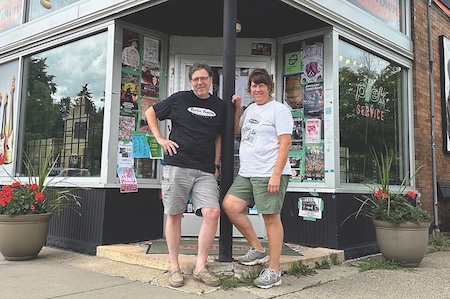
After more than three decades immersed in the ever-shifting MI industry, Twin Town Guitars in Minneapolis stands as both witness to and participant in one of retail’s most dramatic evolutions. What began as a brick-and-mortar operation fueled by local newspaper ads, radio placements and Yellow Pages, has transformed into a digitally attuned ecosystem where visibility is influenced by algorithmic reach.
Owner Andrew Bell has lived every phase of that transition. In the early days, he said he connected with customers by casting a wide but local net, hoping the right player would stumble across a listing or hear a well-timed radio spot. Today, discovery is constant, borderless and, according to Bell, largely dictated by social media.
Today’s guitarist walks through the door armed with an unprecedented level of knowledge. Specs, reviews, demos and comparisons are all easily accessible, creating a consumer who is not just informed, but deeply intentional. Bell describes this moment as a “golden age of opportunity,” when access to information has empowered musicians at every level.
“It’s a golden age from that perspective,” Bell explained. “Customers have all the information about something all the time, whenever they want, as deep as they want to go.”
Customers’ depth of knowledge has, in turn, reshaped demand. Gone are the days of predictable buying patterns or linear brand loyalty. Instead, Twin Town’s sales floor reflects a vibrant spectrum of taste where boutique builders, vintage finds and new staples coexist.
“We carry some great heavy hitter brands like Fender, Gibson, Martin, Taylor and Yamaha, and they have a loyal following, and they do really well in the social spaces as well,” Bell said. “They’re out there in our customers’ purview 24/7 but even lesser known brands have a really good shot, such as the Danelectros, the Warwicks, the Heritages and the G&Ls of the world, will also find a loyal following, and a lot of that is driven socially. From our customer interactions, there’s just no rhyme or reason.”
The Effect of Political Uncertainty
In recent years, economic and political instability have become inseparable from the way musicians approach buying gear, reframing even the most routine purchase as something more calculated. For Twin Town, those pressures became especially pronounced in the wake of post-pandemic inflation and the sweeping tariffs introduced in 2025, factors Bell describes as having a “dramatic impact” on both customers and dealers.
But beyond economics, the social climate in Minneapolis added another layer of complexity. The ICE crackdowns in fall 2025, known as Operation Metro Surge, brought thousands of agents into the Twin Cities, sparking widespread disruption, protests and economic fallout across local communities. The operation led to thousands of arrests with aggressive enforcement tactics and fatal incidents resulting in unrest that filtered directly into the day-to-day rhythm of local businesses with less foot traffic.
“My customers are noticing there’s corporate greed in there,” Bell said. “The economic uncertainty from inflation or wars with Iran or ICE coming into a community and really being disruptive and causing confusion and chaos was strategic on the current administration’s part, and it had huge ripple effects in our community, which were disastrous. It also banded us together and gave us some sort of a community to rally around.”
Bell said there’s economic uncertainty, especially on the dealer side, where the effects were felt from late August to December 2025.
“When I probed, people were saying, ‘$100 doesn’t buy a bag of groceries,’” Bell said. “People are very preoccupied and worried about global disruption from not just tariffs, but from war and aggression, and escalating prices of commodities like oil and food. It feels like we’ve been trying to figure out where that plays a part in this industry since this administration took over.”
Industry of Inclusion
For most retailers, success is defined by the experience they create, whether it unfolds online or across the counter. At Twin Town, that experience ensures customers walk away with exactly what they came for, with staff serving as guides shaping a transaction around the player’s vision.
“This is an industry of inclusion, an industry where we like to celebrate and share,” Bell said. “There’s no better way than to be that conduit for your community — whether it’s pros, collectors or kids, it doesn’t matter. People always can use advice on whether they need to safeguard something that they have with a repair or an appraisal, or getting a kid started to get the next generation interested in being creative with instruments.”
For Bell, staying relevant in an ever-evolving industry demands active participation. That’s where gatherings like The NAMM Show become essential. What began as a search for something new quickly became the heart of how he approaches the business.
“I went to NAMM and it blew my mind,” Bell said. “I started to find out about different pieces of gear that would fit in my community. That’s where I discovered all the tips and tricks about marketing, social media, workshop setup techniques and fostering lesson programs. It is invaluable, and you can’t read about it. It’s an investment in yourself, in your company, and unfortunately, if you don’t go, you’re missing out on a huge chunk of information and an opportunity to connect with people and companies and be proactive about solving your problems that are continuing at your store.”
— By Kimberly Kapela
Twin Towns Guitars’ Pro Tip
“I have never missed a NAMM show,” says Andrew Bell, owner. “I’ve discovered so many tips and tricks about marketing, social media and fostering our lesson program. This is where I bump into people who had solutions to humidity issues or workshop setup techniques. It’s an invaluable experience, and it’s an investment in yourself and in your company. So, my No. 1 tip would be: Go to The NAMM Show. Sign up. Go every year.” MI