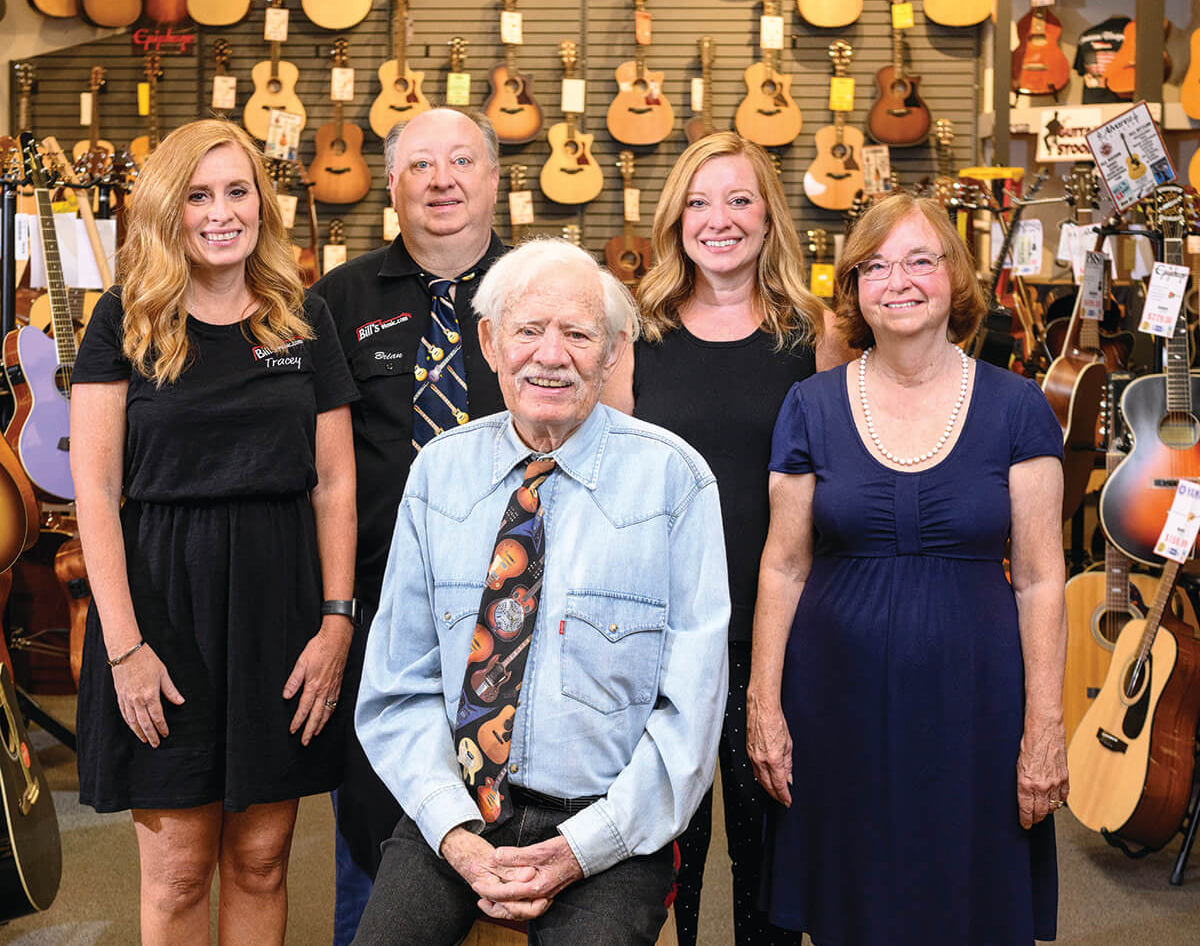

From left to right: Justin Rowan, Atse Theodros, Matt Gasiorowski, non-team member Kyla Moscovich, owner Josh Landress and Peter Harper.
J. Landress Brass is proving to be a true destination for musicians all over the world while continuing to earn its trust as a go-to source for players in New York City. As New York’s last dedicated brass musical instrument store, the boutique shop has created a historic space in one of the most musically rich cities in the world.
“I founded J. Landress Brass in 2012 after working for Sam Ash Music for over a decade and seeing that there was a need in New York for a more catered boutique brass instrument repair shop, and then later turned into a retail store,” said shop owner Josh Landress. “We serve New York City and surrounding areas with professional instruments, brass repairs and restoration as well.”
Growing up, Landress recalls not having a dedicated shop for French horn or other brass instruments.
“For a place that’s really rich in music and in the arts — between Broadway, the jazz scene and the orchestras — there’s nowhere for people to go,” Landress said.
Now, more than a decade later, the shop has grown into something far larger than its original footprint. What makes it a true destination is its intentional curation and experiential approach.
“We have five dedicated practice rooms for people to come and play instruments or for lessons,” Landress shared. “We have a very well curated offering of retail products. Everything that we have here that is available for somebody to play, and that’s coming from the things we have for sale in our very unique museum that we have on display. If you want to play one of Dizzy Gillespie or Louis Armstrong’s mouthpieces, you’re more than welcome to come in here and try that. You can see it, you can touch it, you can play it and spend some time with it. We’ve made that a destination with really unique, one of a kind items and well curated retail.”
PRESERVING HISTORY
A unique aspect of the shop is its own JLB Museum, a curated in-store collection of historically significant instruments and artifacts musicians won’t see elsewhere. Far from a traditional behind-glass exhibit, the museum invites interaction and helps make the shop a place to experience brass history up close and in a more hands-on way than a traditional museum setting.
“It started off with just a couple small mouthpieces that belonged to famous musicians and I wanted to display it,” Landress said. “Some things that we have in the collection are generously donated on a permanent loan from people who might have had something or were friends with a musician who was well known. We’ve then either bought or kept some for us to then have so that we can continue the story of these musicians.”
What began as a love for collecting things as a child has grown into a labor of love and an expression of Landress’ lifelong instinct to preserve.
“Now as a professional and in this small boutique business, to be able to collect something that has such important historic value as some of the things that are in our collection, to be able to have those available for people to look at, play and try, is really cool,” Landress said. “Museums have great things on display, but they have so much more stuff hidden away in their archives and catacombs, boxed up that people can’t see and can’t appreciate. Part of my belief is that music is an oral storytelling that’s passed down, and to have gear that we grew up listening to is really neat to have and to share with the world.”
Today, the JLB Museum houses roughly 200 historical items, including about 50 mouthpieces once owned by iconic players. Among them are pieces tied to legends like Dizzy Gillespie, Louis Armstrong, Miles Davis and Clark Terry. The collection also features approximately 25 instruments, along with mutes, practice books and rare ephemera that trace the lineage of brass performance across generations.
“I also have other preserved pieces of history, like a mute from the ’50s that’s still sealed in its container and has never been used,” Landress said. “We have a big picture that is signed by 200 prominent trumpet players that a trumpet player carried with him and had people sign for 40 years. I have the oldest known modern B flat trumpet. I just acquired some really cool diaries from Vincent Bach’s wife from the mid-’20s, so we’re constantly acquiring things like that to contribute to the museum.”
FROM THE BENCH
Beyond its curated instruments and museum, J. Landress Brass gives musicians a rare, behind-the-scenes view of what goes into keeping a horn in top form. The shop’s “behind the bench” content highlights restoration, customization, and everyday repair work. This transparency not only reassures customers that their instruments are in expert hands, but also reinforces confidence in the shop’s vintage and pre-owned offerings.
“A lot of these days, a repair shop at a music store is always hidden in the back,” Landress said. “The repair shop should be at the front of the music store, so that when people come in, they can see that there is a group of people who can take care of their instruments. People don’t know the work that goes behind that, so it’s very important for our clients to know what we’re capable of and what goes into repairing an instrument.”
He recalls the lasting impact of historic New York music stores, like Giardinelli’s, which opened in the late 1940s and remained a legacy for decades.
“I want our repair work to stand in and of itself for people to say, ‘I was able to do my job because these guys took care of my instrument for 30 years,’” Landress said. “Because I do a small number of handmade instruments and custom-built instruments, I want somebody to say, ‘This is a Landress trumpet.’ I just want that to last.” MI